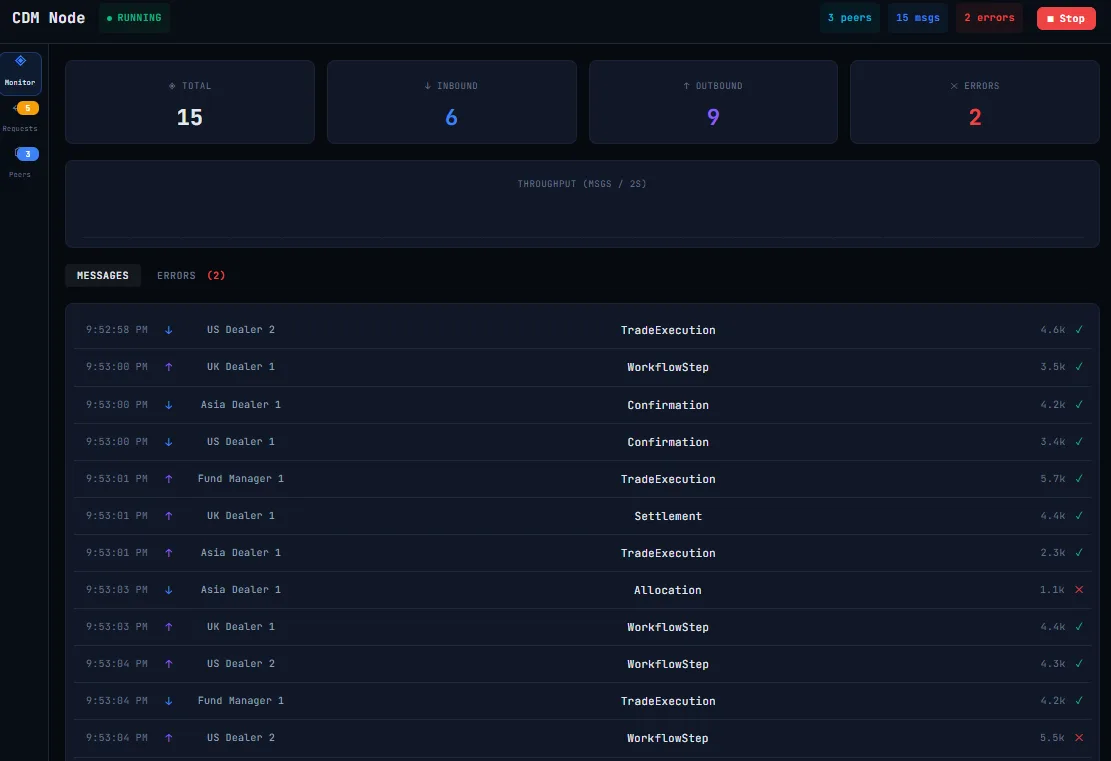
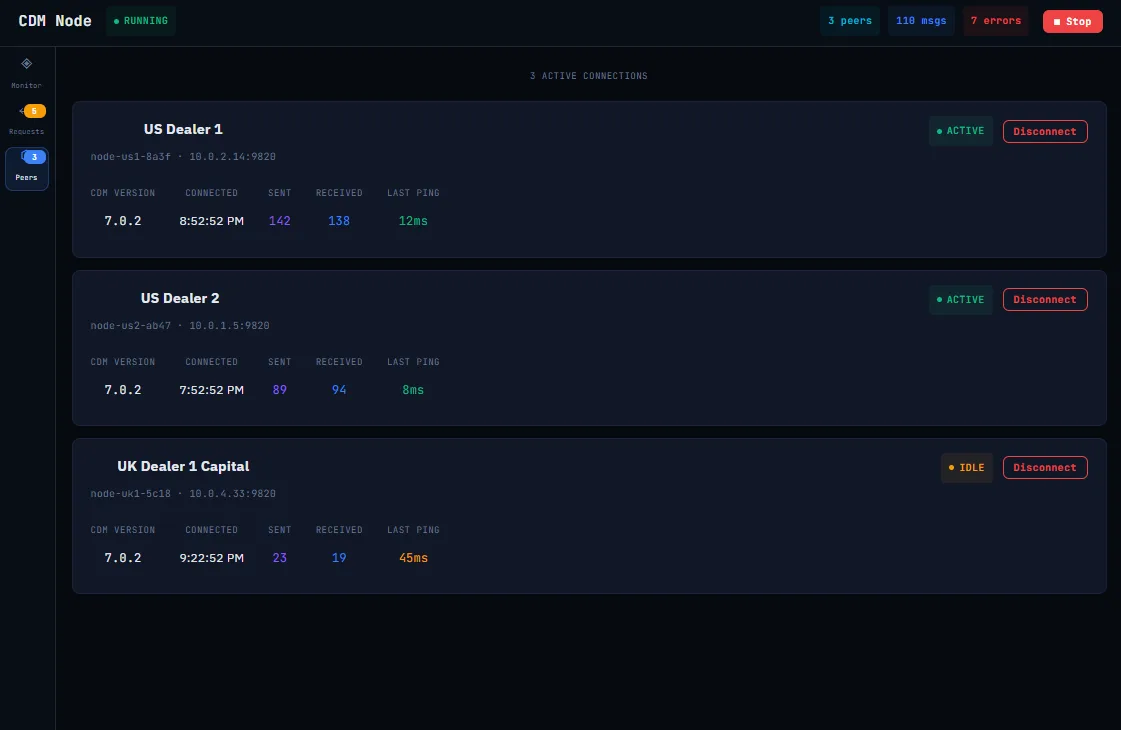
The CDM ships as a library, and a library only runs when something calls it. CDM Node wraps the model in a service architecture — always on, routing CDM objects between your own systems and out to counterparties. CDM Net connects those nodes into a private network.
Runs internally or externally · Blockchain optional · Java 17
Node is not one process. It is three, split along the lines a bank already segments its network — so the component facing the internet is not the component holding your trade data.
Peer to peer CDM connectivity.
Faces the internet. Finds peers, accepts inbound traffic and passes it inward without ever opening the payload — so compromising the gateway does not expose CDM business data.
Validate, store and route CDM objects.
Where CDM objects actually live. Validates them against the model, persists them, and routes them between your applications and out through the gateway. Stays on the secure network and is never exposed directly.
Connect to a private or public blockchain and execute smart contract services.
The gateway to a chain. Commits and confirms event hashes, and executes smart contract services. Sees hashes, never trades — and it is entirely optional. Run the first two nodes and never touch DLT if that is not your world.
Add a D-Node and each firm independently commits the same CDM event to a shared chain. When both have confirmed it, the record is attested — a tamper-proof bilateral audit trail neither side can quietly revise.
The event hash is on chain. The counterparty has not confirmed it yet.
Two independent confirmations of the same event. One agreed version of the trade.
A disagreement surfaces immediately, at the point it happens, rather than at end of day.
The window closed unconfirmed, and that fact is recorded too.
Only hashes go on chain. Trade data never leaves your infrastructure, so an attestation proves two parties held the same event without either publishing what it contained.
The three-tier split is the reason a bank can approve this. Each node sits in the zone it belongs in, and the data each one can see is bounded by design rather than by configuration.
| Node | Network zone | Sees | Exposed to |
|---|---|---|---|
| E-Node | DMZ | Opaque payloads only | The internet |
| I-Node | Secure zone | CDM business data | Internal network only |
| D-Node | DLT zone | Hashes only | Chain endpoint |
Nodes negotiate on connection. Each side advertises the CDM versions it supports, and the handshake settles on a version both can speak — so a counterparty running an older release is a compatibility check rather than a blocker.
Move CDM objects between your own applications. No counterparties, no chain — just the model running as a service across your estate.
Add gateways and exchange CDM events directly with other firms, peer to peer. CDM Net handles the connectivity.
Add a D-Node when you want an agreed, tamper-proof record of what both sides confirmed.
Built with CDM Workbench — workflows designed and tested there run here.
Start with an internal router, add counterparties when you are ready, and add the chain only if you need it.