Design, build, test and deploy CDM applications — then connect them. Tooling, servers and a network for the teams putting the Common Domain Model into production.
No signup required · Free examples and code on GitHub
One model. One library. The CDM is a shared definition of products and lifecycle events, and the software library that implements them. Integrating it across a trading enterprise means mapping data feeds (FIX, XML, FpML and others) into the CDM, building APIs, persisting CDM objects, and connecting to real-time services and messaging infrastructure. These are the tools for designing, building and managing your CDM integration.
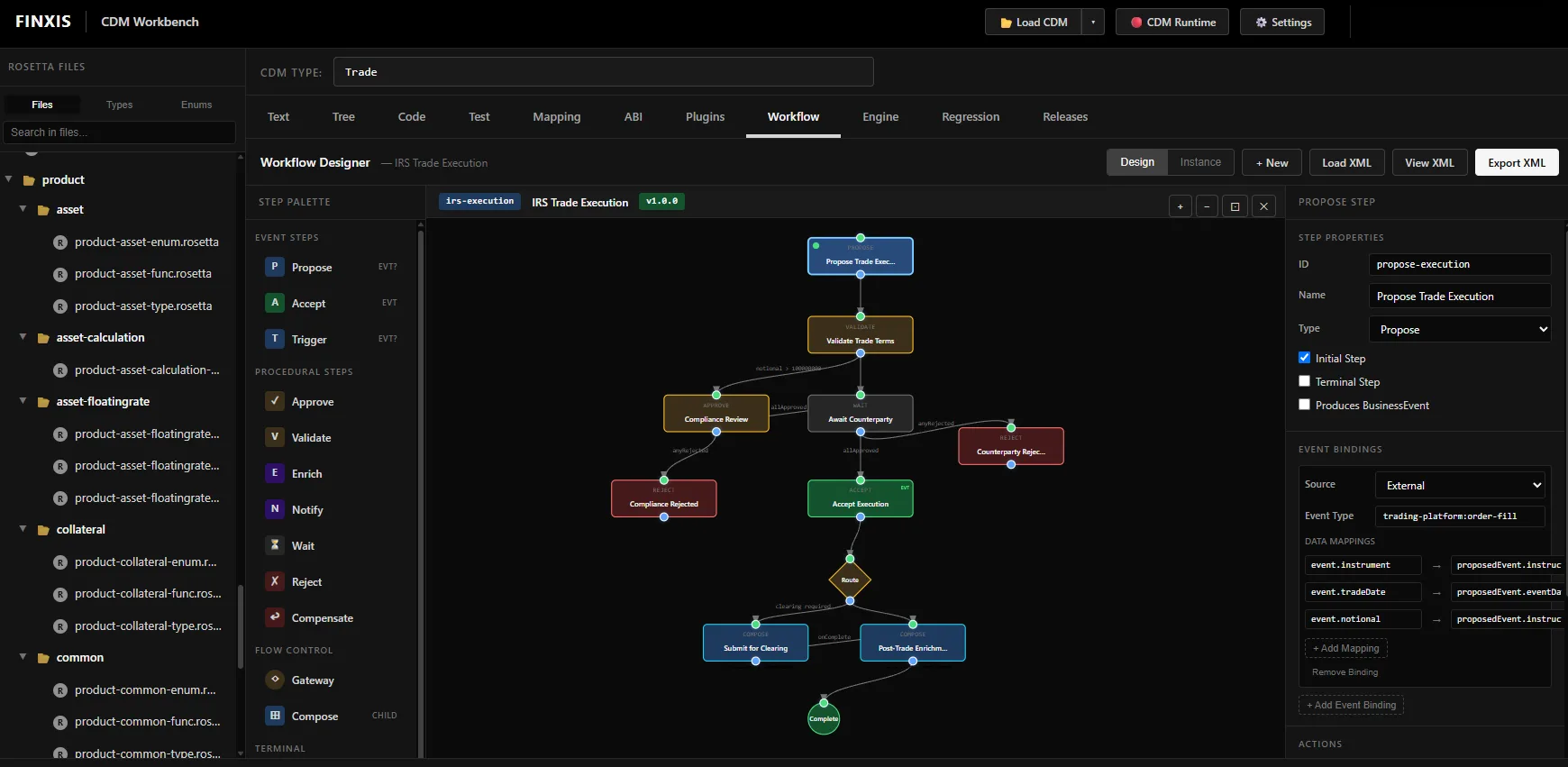
Browse types, attributes and cardinality. Map external formats and messages onto CDM.
Produce Java, JSON or Rune from a description. Test functions and run regressions.
Stand up CDM servers that message and transact CDM events across DLT and non-DLT platforms.
Link nodes to counterparties and clients over a private CDM network.
Tools to build CDM applications, integrate with external services, deploy across the enterprise and connect them. Each runs as a standalone web application.
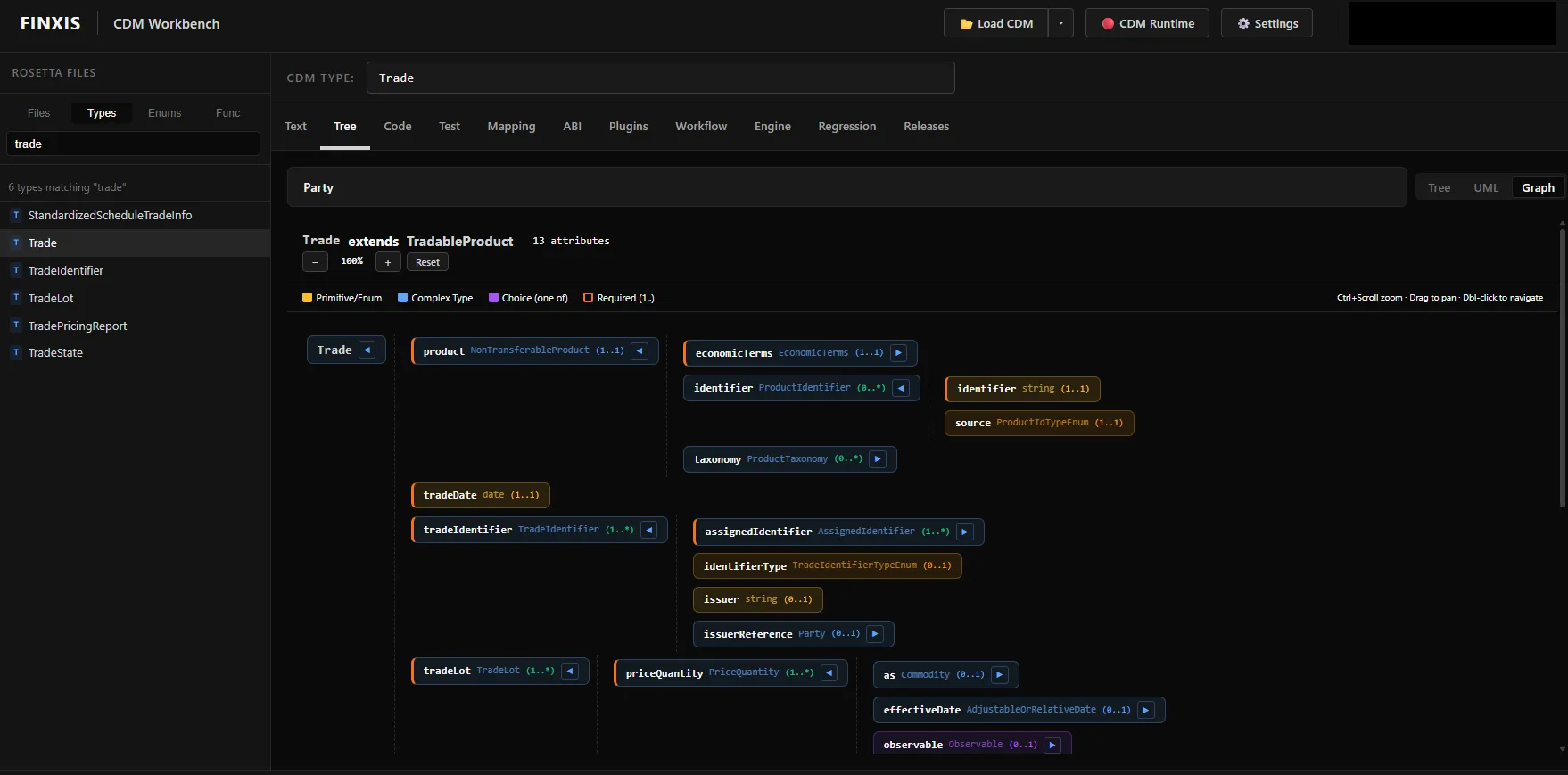
Explore any CDM type as a tree, a UML view or an interactive graph. Cardinality, required attributes, choices and complex types are colour-coded as you navigate.
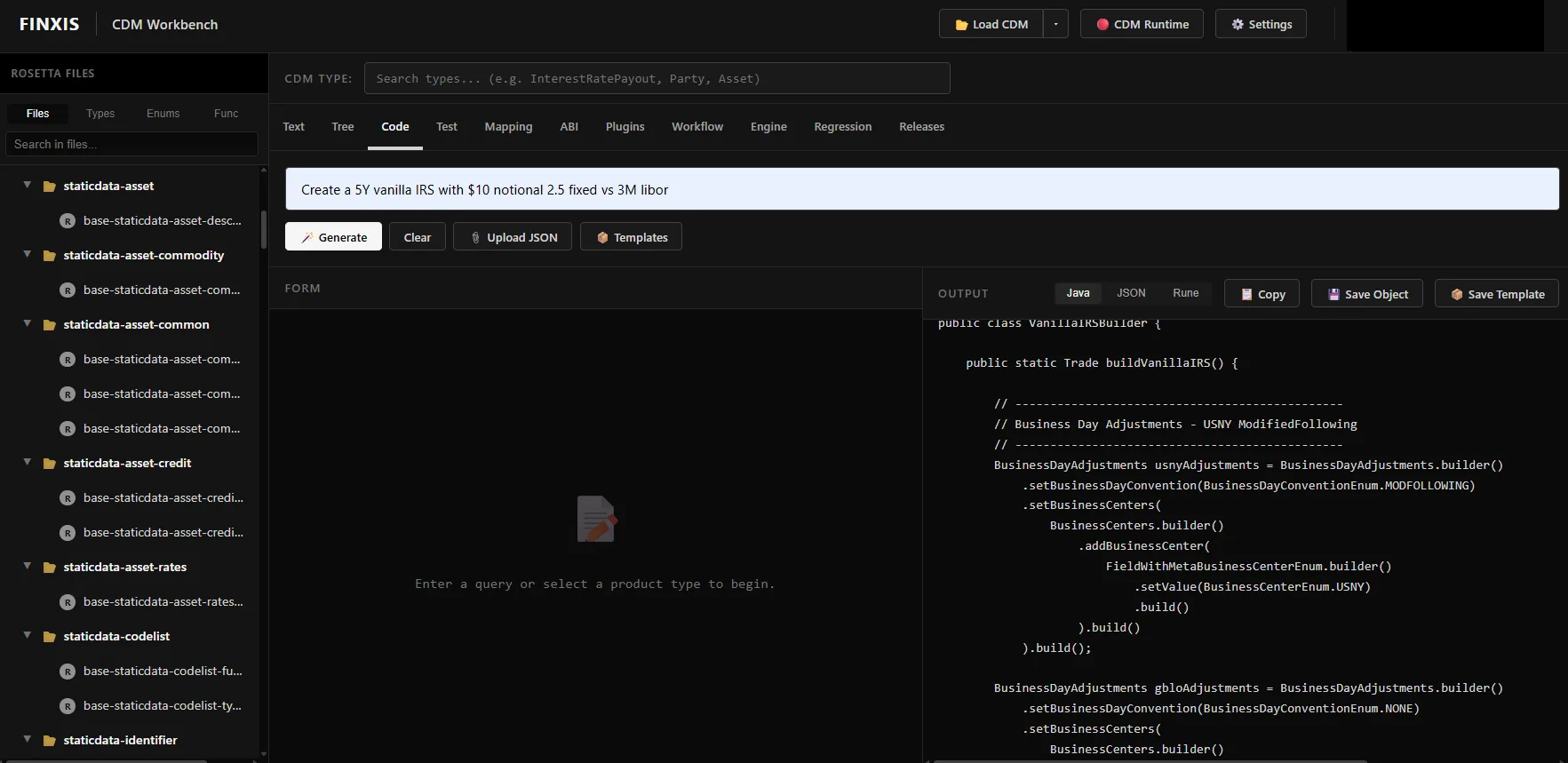
Enter a plain-language description — a 5Y vanilla IRS, $10m notional, 2.5 fixed against 3M Libor — and generate a valid CDM object as Java, JSON or Rune. Review it, save it, or keep it as a template.
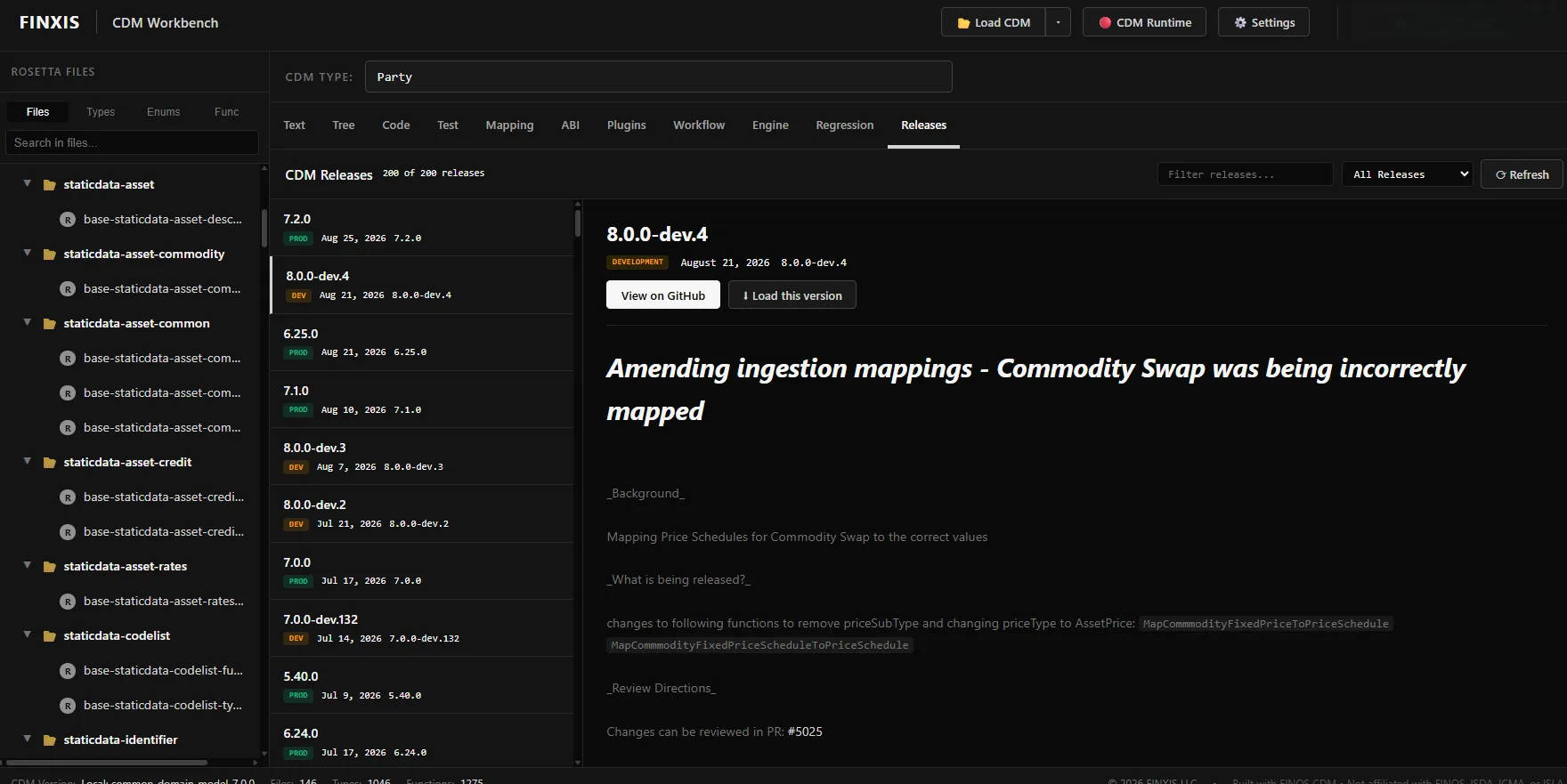
200+ CDM releases, production and development, with notes and a direct link to GitHub. Load any version and run your model against it — so a migration is something you test before you commit to it.
We track the standard release by release. Production lines and development branches, all loadable, so you can see what a version change does to your model before it does it.
| Version | Status | Released | Line |
|---|---|---|---|
| 7.2.0 | Prod | Aug 25, 2026 | Current production |
| 8.0.0-dev.4 | Dev | Aug 21, 2026 | Next major |
| 6.25.0 | Prod | Aug 21, 2026 | Maintained |
| 7.1.0 | Prod | Aug 10, 2026 | Maintained |
| 7.0.0 | Prod | Jul 17, 2026 | Maintained |
| 5.40.0 | Prod | Jul 9, 2026 | Maintained |
Open tools and working code for the FINOS CDM community. No signup, no licence, no sales call.
Traverse the full CDM tree in your browser. Inspect types, attributes, cardinality and conditions across releases — the same viewer that ships inside Workbench.
Open Model BrowserSample CDM objects, mapping templates and reference implementations on GitHub. Fork them, break them, use them in your own build.
View on GitHubMessaging standards agreed how to send a trade. None of them agreed what a trade is — so every firm built its own interpretation, and every connection needed a translation. The CDM standardises the representation itself.
FIX standardised how systems talk to each other. Every firm still modelled the trade its own way.
FpML and ISO 20022 standardised the envelope and its fields. Semantics and lifecycle logic stayed proprietary.
The CDM standardises products, events and processes as executable logic — shared, versioned and machine-readable.
Finxis has delivered CDM implementations at industry scale, including the CDM for repo and bonds and the Bond Data Taxonomy for ICMA.
Assessment, implementation and migration — from proof of concept to production rollout across the trade lifecycle.
Practical education for the teams implementing it: developers, data modelers, architects and business analysts.
Independent review of your CDM implementation against the CDM’s canonical products and design practices.
Open the free Model Browser, pull the examples from GitHub, and talk to us when you hit something you would rather not build twice.