CDM Net is a configurable private network of CDM Nodes. Traffic runs peer to peer over WireGuard — it does not route through us, or through anyone else. A counterparty connects in minutes rather than in a project.
Self-deployed · Peer to peer · Per-firm keys
You run CDM Net. It is your network, across your firm and the counterparties and clients you connect to it. Nothing passes through a vendor, and there is no shared infrastructure holding your traffic.
Net connects the external-facing E-Nodes. Your I-Node — where CDM objects actually live — stays inside the secure network and is never exposed.
WireGuard tunnels with unique keys per firm. Traffic goes directly between the two parties to it.
No hub, no relay, no vendor sitting between you and your counterparty. There is nothing in the middle to trust, subpoena or take offline.
Standing up a private link between two firms is normally weeks of coordination — key exchange, firewall rules, peer configuration, someone maintaining a spreadsheet of who is connected. CDM Net replaces that with a download.
Through the onboarding portal, once.
A WireGuard configuration with keys unique to that firm.
Network configuration already filled in. The firm adds its wallet key.
The node comes up on the network and starts discovering peers.
The difference matters commercially, not just operationally. If every new counterparty is a bilateral IT project, the network never grows past the firms with budget for one.
A joining node presents its firm LEI, public key and a signed handshake. Your node verifies the signature, checks protocol and CDM version compatibility, and confirms the capabilities on offer — then you accept or reject. Automatic discovery finds peers; it does not admit them.
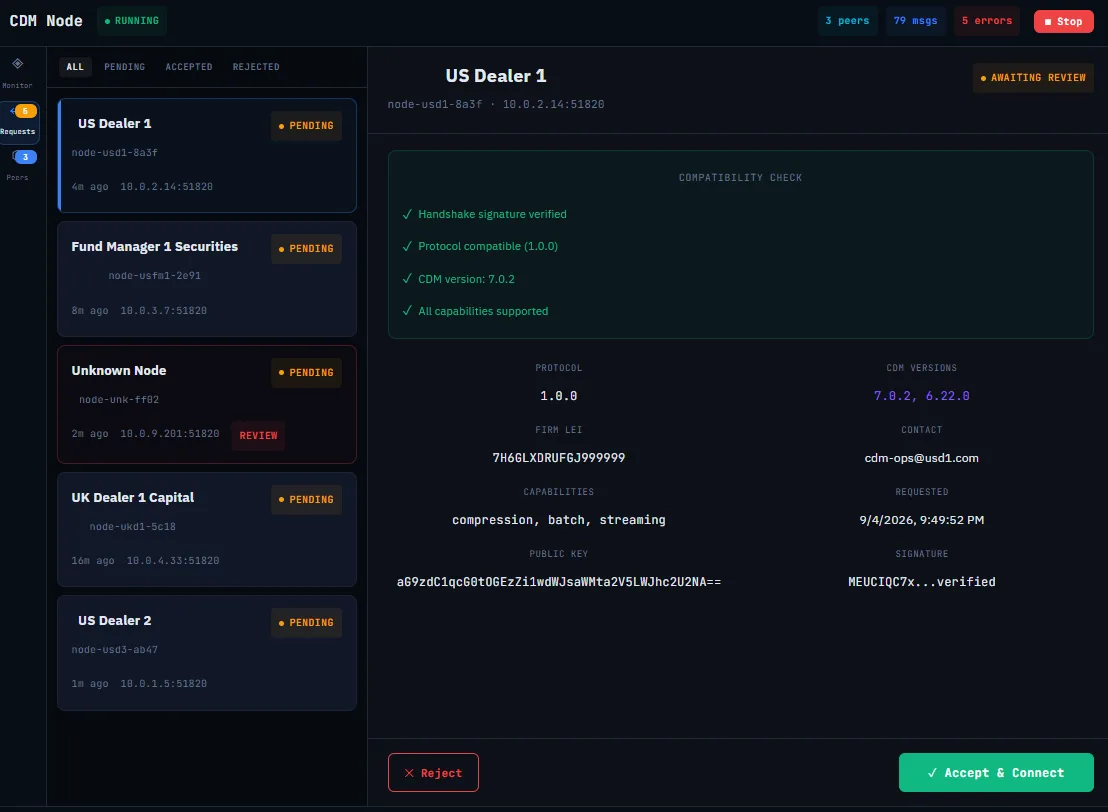
A directory of who is connected, so a node does not need to be told about every peer in advance. New firms appear as they join, and existing nodes discover them without reconfiguration.
The current membership of your network, visible to the firms on it.
Nodes resolve peers from the directory rather than from a hand-maintained list.
Adding the tenth firm costs what adding the second did.
Optional network monitoring shows which firms are up and which are not. It does not show message content — there is no visibility into what any node is sending, by design rather than by policy.
| Monitoring shows | Monitoring never shows |
|---|---|
| Connection status per firm | Message content |
| Uptime across the network | CDM objects or trade data |
| Which peers are reachable | Who traded what, with whom |
Because you deploy the network yourself, the operator is you. Any uptime commitment on it is one you make to your own clients.
Deploy the network, onboard a firm, and let the nodes find each other.